
What the “digital natives” myth is costing our children
More technology use. Less ability to evaluate what's on the screen. The data, and the assumption that should be retired.

In mid-2025, David Didau made the point that calling young people digital natives oversells what they can actually do with technology.[1] The evidence available to him then has since been built upon and developed, offering new insights, and the 2026 results from the IEA’s International Computer and Information Literacy Study (ICILS)[2] have now made the argument empirical, with a decade of measurement showing use rising while critical evaluation declines.
ICILS is the most rigorous international measurement of student digital capability we have. Three cycles, ten years, more than 130,000 students per cycle in dozens of countries. Students aged 13 to 14 years old complete computer-based tasks under timed conditions. They are required to find information, evaluate a website, judge whether a source is reliable, and produce a digital artefact. The scoring is a direct measurement of what students can do, not what they say they can do.
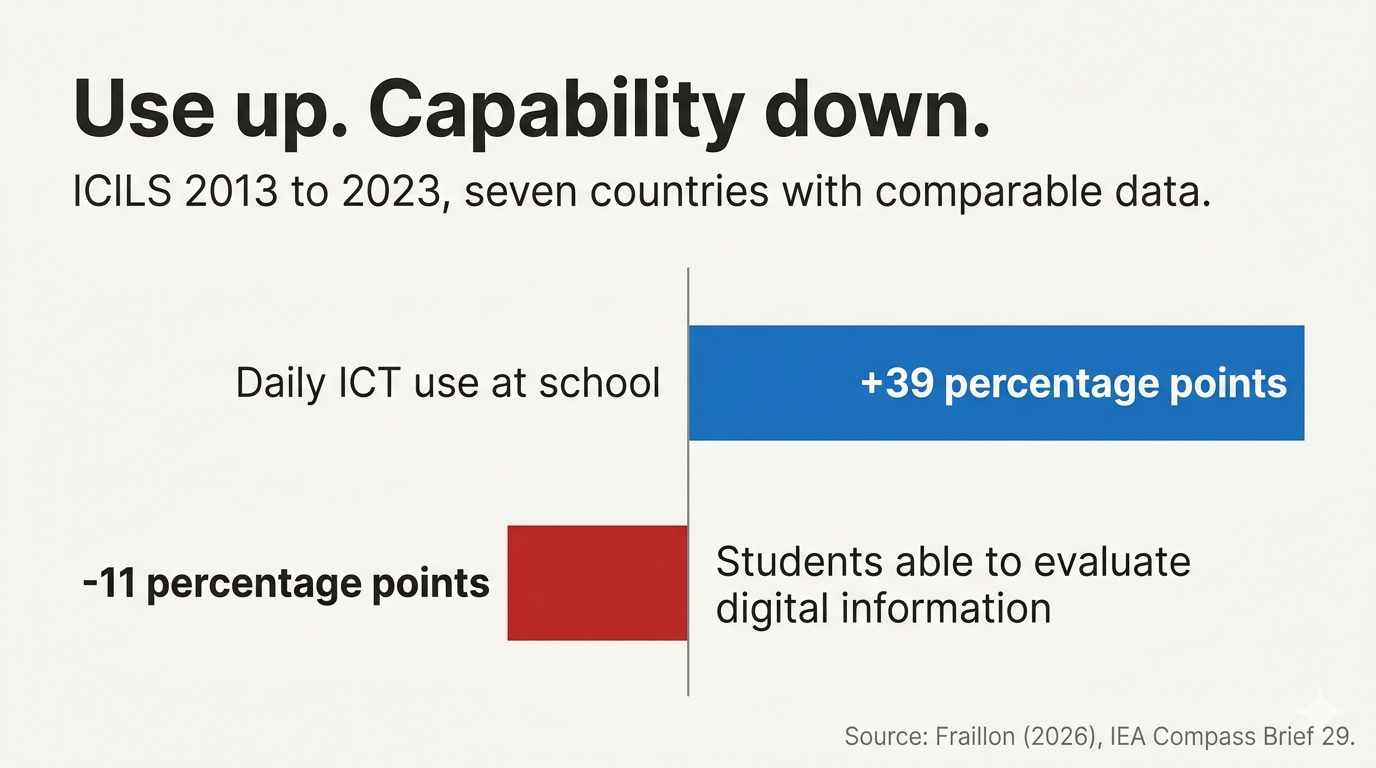
Between 2013 and 2023, across the seven countries with comparable data, the share of students reporting daily ICT use at school rose by 39 percentage points. Over the same period, the share of students reaching the level at which they can begin to evaluate digital information independently fell by 11 percentage points. Use went up. The ability to use it well went down. The two trends have moved in opposite directions for a decade.[3]
Julian Fraillon, ICILS's International Study Director, is explicit about what the data shows when he writes that the “increased exposure to ICT alone does not correspond to increased student CIL achievement.” Even more direct is his statement that “the unsubstantiated belief that they belong to a generation of inherently skilled technology users may have fostered unrealistic perceptions of their own digital capabilities.” Three-quarters of students on average across countries cannot list one way of checking the credibility of a website. Large majorities believe they can judge trustworthiness moderately well. The data clearly shows that this isn’t the case.[4] Fraillon points at Marc Prensky’s 2001 essay Digital Natives, Digital Immigrants as the source that current evidence now refutes.[5]
It is worth considering not only what the data says, but the converse, what it doesn’t say.
ICILS measures the evaluation of digital text. Reading a website, weighing the credibility of a source, judging the reliability of written information. That is an important capability, and it is the capability schools still depend on for almost everything they assess. It is concerning that the decline recorded by ICILS is in a skill that the system still needs.
A 2018 OECD finding that only 12% of fifteen-year-olds could correctly identify a phishing email is often cited as evidence of digital incompetence. The figure is less robust than it looks. Stop to consider how many fifteen-year-olds use email, even in 2018. In general, they don’t. Some have school accounts that they probably barely open. Asking them to spot a phishing email tests recognition of a medium that is not, for many of them, their way of communicating. ICILS does not have that problem. It puts students in front of websites and tasks they encounter routinely, and measures what they actually do.
The medium most young people now use for information is not text. It is video, short-form and long-form, served algorithmically, supplemented by audio and often subtitles. No international assessment yet measures young people’s ability to evaluate the credibility of video content at anything like ICILS’s rigour. Media literacy scales exist but they rely on self-report. While performance-based studies exist it’s at a small scale, in single countries, or focused on instructional videos rather than the algorithmic short-form feed. There is no international study of 130,000 students completing performance tasks on the medium most of them now use most, short-form video.[6]
The cognitive demands of the two media are not interchangeable. Maryanne Wolf, a cognitive neuroscientist at UCLA, has spent twenty years researching what reading does to the brain. She and her colleague Mirit Barzillai defined “deep reading” as the “array of sophisticated processes that propel comprehension and that include inferential and deductive reasoning, analogical skills, critical analysis, reflection, and insight.”[7] These are the same processes critical evaluation requires, but they are not automatic. Wolf’s concern, expressed long before TikTok existed, was that a digital culture that emphasises immediacy, information loading, and speed could discourage the deliberation these processes need.
You can watch a video deeply, with attention. The medium does not preclude it but deep attention is not the same as critical evaluation. Both reading and watching ask the same questions of the content — who is speaking, what they want, what they have left out — and those questions have to be taught regardless of the medium. The difference is that reading, by default, invites the reader to slow down, while short-form video, by default, keeps the viewer moving forward. The deep reader and the deep watcher both have to work against that default. The number of young people learning to do that on video is something that, currently, can’t be measured as rigorously as we can measure reading text.
The default for short-form video is not accidental. Internal documents from Meta unsealed in November 2025 showed that the company knew for years that its engagement-optimised designs harmed young users. In March 2026, a California state-court jury found Meta and YouTube negligent for designing platforms in ways that harmed a minor plaintiff.[8] Platform design is not a cognitive consequence inferred from neuroscience. It is a documented engineering decision.
There is also the question of what the algorithm does with the content once a young person engages with it. Recommendation systems on YouTube, TikTok, Instagram and others optimise for engagement, which in practice means serving more of what the user has already watched to completion. Which means that the educational video that they only watched part of, and didn’t finish won’t trigger the algorithm, or not to the same extent. A 2025 systematic review of a decade of research on filter bubbles and youth found that algorithmic systems structurally amplify ideological homogeneity, reinforce selective exposure, and limit viewpoint diversity. The polarisation consequences are still contested in the experimental literature but the mechanism — more of the same — is not.[9]
There is one further point, which is that the processing routines of critical evaluation — pausing, asking who is speaking, asking what they want, asking what has been left out — can, in theory, be taught in the abstract, but they cannot be applied without subject knowledge. Teaching the process is one thing. Applying it to a given situation is something quite different. A student who has been taught to ask “what is being left out” cannot answer that question about a video on quantum computing if they know nothing about quantum computing. They might evaluate the video itself, drawing inferences from that about the quality of the content, but that isn’t the same thing. The cognitive science is unambiguous about the fact that critical thinking is what knowledge does when it’s working.[10] Generic critical thinking programmes produce modest effects on their own. Combined with content-specific instruction, the effects are substantially larger. The reason probably isn’t that mysterious; it’s likely that it’s largely about the student. Generic instruction teaches a process.
Applying that process depends on knowing enough about the subject to make the connection. The students most likely to make the connection unprompted are the students who already have the habits of effort and the domain knowledge to do so. Not enough will. What does work is teaching evaluation routines alongside the subjects students are studying, in the media they actually use. The digital natives label assumes that ability is already there. It isn’t, and it doesn’t arrive on its own.[11]
I have written before on this Substack about why governments produce AI plans without strategies, about the costs that gap inflicts on schools and about why teacher CPD designed without diagnosis fails the people it is supposed to develop. Three pieces, one argument, all on the teacher and institutional side of the system. The student side has been quieter in those pieces but the ICILS evidence allows that gap to be filled.
The mistake we make about students is the same mistake we make about teachers. We tell ourselves that because they’re using the technology, they must have learnt how to use it and so must know what they are doing with it. The data strongly suggests that too many in either group do not, but neither appears to learn what they were expected to. The OECD’s January 2026 Digital Education Outlook records what the double mistake looks like in one number. In Estonia, an early-adopter system with 27 years of digital strategy behind it, 50% of upper secondary teachers use generative AI in their work. 90% of their students do. Teachers seem to use these tools to the same or to a lesser extent than their students, but not more.[12]
The teachers are not ahead of the students. They cannot model what they do not know how to use properly, since they have not received the requisite professional development. The students have not been taught what they are assumed to know already. Governments fund the rollout for both groups, and neither acquires what was supposed to follow. Use is rising for everyone, but the ability to use it well is rising for nobody.
PIRLS 2026 is being administered in classrooms right now and it completes the transition to a fully digital reading assessment, with the IEA stating that the format will reflect “students’ many reading experiences in- and out-of-school”and collect “process data about how students proceed through the assessment, making it possible to examine the response strategies and processes used by successful readers.” PISA 2025 results land in September 2026, with the new Learning in the Digital World domain following in 2027. PISA 2029 will be the first international cycle to include a Media and Artificial Intelligence Literacy domain, with results around 2030.[13] The children sitting these assessments were born around 2014 to 2017. They will be teenagers before we have rigorous international evidence on what an GenAI-rich learning environment has done to their reading and reasoning. The assessment cycles, like everything else in educational policy, are fundamentally mismatched to the speed of the change.
This is not a deficit in young people, and they are not less capable than the generation before them. However, the conditions in which critical evaluation develops have changed as has the medium that dominates their attention. The explicit teaching that would build that capability has been treated as optional because the system has been told, and believes, that it’s not necessary.
Children who get the teaching at home, from families that read together and check sources at the dinner table, do fine. The children who depend on school to provide the necessary education are the ones the assumption fails most. ICILS finds digital capability mapping onto socioeconomic background as cleanly as reading literacy has always done. Parental education, books in the home, home language match with the test language, computer access at home.[14] The equity gap that the digital natives label was supposed to close is sadly, and ironically, exactly the gap it’s helping to preserve.
Calling young people digital natives is convenient. It saves money on assessment, on curriculum work, on teacher training and professional development. It’s convenient as it lets the gaps go unaddressed. The savings are real. The cost falls on classrooms, and hardest on the children least likely to get the teaching anywhere else. The data showing this is now international, recent, and hard to argue with.
Notice, though, that the conversation has already moved on, and is now about AI literacy. The gap the digital natives label papered over for twenty-five years is now being skipped past in favour of a new gap. The concern, and the risk, is that this is presumed to be the priority. It is, but only if the digital literacy gap is closed first. The next assumption is taking shape on top of the unresolved one underneath, which means that the attempt to build AI literacy risks failing in the same way the attempt to develop digital literacy appears to have done. The reason would be a simpler one — the almost total lack of the necessary foundation.
The deeper risk is that we don’t yet have enough data, enough knowledge, or enough understanding of GenAI and how young people interact with it to know what the right response is. That is why data matters. That is why the work now is questions and nuance, not polarised positions driving stances. The harder job, in some roles, is genuinely discussing and thinking, not reacting. The questions below are the start of that thinking, not the end of it.
Does AI literacy require digital literacy as a foundation?
It probably helps. It probably supports, directs, accelerates. How essential is it? That is a question the evidence does not yet answer.
Some AI literacy is about understanding the technology itself.
What generative models do mechanically. Why they hallucinate. What they are good and bad at. That can be taught directly, without strong digital reading skill. Whether it is enough — whether a student who knows what a model does can therefore evaluate its output — is a different question.
Could AI use, framed properly, build digital literacy rather than depend on it?
The AI gave you that answer. How do you know it’s right? is the same question schools are meant to be asking about every digital source. A teacher who scaffolds AI use carefully may be teaching digital literacy under another name. Whether that works at scale, and whether it produces the depth ICILS measures, is open.
[1]: Didau, D. (2025). “Is the curriculum to blame for plummeting attendance?” The Learning Spy (Substack), 9 June 2025. Didau’s piece marshals the OECD phishing figure, the 2019 Stanford sponsored-content study, and UK general election turnout data to argue against the digital natives assumption. The Fraillon evidence cited in this article was not yet published at the time of his piece.
[2]: ICILS is conducted by the International Association for the Evaluation of Educational Achievement (IEA), the same organisation that runs TIMSS (Trends in International Mathematics and Science Study) and PIRLS (Progress in International Reading Literacy Study), among other comparable studies. See https://www.iea.nl.
[3]: Fraillon, J. (2026). Compass Brief 29: Digital Natives — Reality or Myth? Evidence from IEA’s International Computer and Information Literacy Study. IEA. The seven-country trajectory comparison covers ICILS 2013, 2018 and 2023.
[4]: Fraillon, J. (Ed.) (2025). An International Perspective on Digital Literacy: Results from ICILS 2023. Springer. ISBN 978-3-031-87721-6. More than 130,000 eighth-grade students across 34 countries plus one benchmarking entity. CIL distribution finds 51% of students globally at Level 1 or below, meaning they cannot complete digital tasks without explicit instruction. Only 1% reach Level 4, the level of evaluative judgement and precise control.
[5]: Prensky, M. (2001). “Digital Natives, Digital Immigrants.” On the Horizon, 9(5). Cited by Fraillon (2026) as the label the ICILS evidence now empirically questions.
[6]: There is no international large-scale assessment of student ability to evaluate short-form video content at the rigour of ICILS. Media literacy scales exist but rely on self-report. Performance-based studies of online source evaluation exist at smaller scale and in single countries, but none combines ICILS-level sample sizes, international comparability, and a focus on algorithmically-served short-form video.
[7]: Wolf, M., & Barzillai, M. (2009). “The Importance of Deep Reading.” Educational Leadership, 66(6), 32-37. Wolf is Director of the Center for Dyslexia, Diverse Learners, and Social Justice at UCLA, with more than 170 scientific articles in cognitive neuroscience and reading.
[8]: Internal Meta documents unsealed in November 2025 in the federal multi-district litigation In re Social Media Adolescent Addiction (MDL 3047, Northern District of California) include a 2018 internal Meta researcher’s note that the company’s product “exploits weaknesses in the human psychology to promote product engagement and time spent”(Tech Oversight Project, 22 November 2025; coverage in Time, Newsweek and CNN). On 25 March 2026, in K.G.M. v. Meta et al. (Los Angeles Superior Court, JCCP 5255), a California state jury found Meta and Google negligent in the design of Instagram and YouTube respectively, awarding the 20-year-old plaintiff $6 million in damages (NPR, 25 March 2026; Al Jazeera, 26 March 2026). Both companies have signalled intent to appeal.
[9]: Ahmmad, M., Shahzad, K., Iqbal, A., & Latif, M. (2025). “Trap of Social Media Algorithms: A Systematic Review of Research on Filter Bubbles, Echo Chambers, and Their Impact on Youth.” Societies, 15(11), 301. DOI 10.3390/soc15110301. Systematic review of 30 studies (2015-2025) across Facebook, YouTube, Twitter/X, Instagram, TikTok and Weibo, finding that algorithmic systems structurally amplify ideological homogeneity and reinforce selective exposure. The political polarisation consequences of these mechanisms are contested in the experimental literature: see Liu, N. et al. (2025), “Short-term exposure to filter-bubble recommendation systems has limited polarization effects: Naturalistic experiments on YouTube,” PNAS 122(8), e2318127122. DOI 10.1073/pnas.2318127122.
[10]: Willingham, D.T. (2009). Why Don’t Students Like School? A Cognitive Scientist Answers Questions About How the Mind Works and What It Means for the Classroom. San Francisco: Jossey-Bass. Chapter 2. The position is shared by Kirschner, Sweller and Clark, among others.
[11]: Abrami, P. C., Bernard, R. M., Borokhovski, E., Waddington, D. I., Wade, C. A., & Persson, T. (2015). “Strategies for Teaching Students to Think Critically: A Meta-Analysis.” Review of Educational Research, 85(2), 275-314. Meta-analysis of 341 effect sizes. Generic critical thinking outcomes produced a weighted mean effect size of g+ = 0.30. Content-specific outcomes produced g+ = 0.57. Of the four instructional approaches in Ennis’s (1989) taxonomy, the “mixed” approach (combining generic with subject-specific instruction) produced the largest effect (g+ = 0.38); generic instruction alone produced g+ = 0.26.
[12]: OECD (2026). Digital Education Outlook 2026: Exploring Effective Uses of Generative AI in Education. OECD Publishing, Paris. The Estonia figure comes from TALIS 2024 adoption data reported in Chapter 1.
[13]: PIRLS 2026 is being administered across 2026, with results expected late 2027 to 2028. PISA 2025 main results release in September 2026; results from its new Learning in the Digital World innovative domain follow in 2027. PISA 2029 will be the first cycle to include a Media and Artificial Intelligence Literacy innovative domain, with results expected around 2030-2031. Sources: IEA (iea.nl); OECD PISA programme.
[14]: Fraillon (2025), equity correlates section. The list of socioeconomic correlates of digital capability — parental tertiary education, books in the home, home language match with the test language, home computer access, internet reliability — closely mirrors the equity correlates of reading literacy in PISA across multiple cycles.